





What is a Spray Dryer and How does a spray dryer work?
 Jul 23, 2025|
 View:3821
What is a Spray Dryer?
A spray dryer is an industrial continuous drying system that rapidly converts a liquid feed (solution, suspension, emulsion, or pumpable paste) into a dry powder or granular solid. It accomplishes this in a single step by atomizing the liquid into a hot gas stream within a drying chamber. Spray drying is renowned for its ability to handle heat-sensitive materials (like foods, pharmaceuticals, and biologicals) while producing powders with controlled properties like particle size, density, moisture content, and flowability.

Key Advantages Driving Adoption:
Single-Step Drying: Combines evaporation and drying.
Rapid Processing: Drying occurs in seconds (typically 10-30 seconds).
Gentle on Heat-Sensitive Materials: Low particle temperatures during most drying.
Powder Quality Control: Tailor particle size, density, morphology.
High Scalability: Works efficiently from lab/pilot scale to massive industrial production.
Aseptic Production: Possible with closed, sanitizable designs (critical for pharma/food).
Solubility/Reconstitution: Often produces highly soluble powders (e.g., milk, coffee).
Continuous Operation: Ideal for large-volume manufacturing.
Core Components of a Spray Dryer:
Feed System: Pump (e.g., peristaltic, diaphragm, piston) delivering liquid feed at a controlled rate. May include pre-heating/cooling.
Atomizer: The heart of the system. Breaks the liquid into fine droplets (increasing surface area exponentially). Types:
Rotary Atomizer (Wheel/Disk): Centrifugal force spreads liquid into droplets. Handles viscous feeds, wide particle size distribution.
Pressure Nozzle: Forces liquid at high pressure through an orifice. Produces coarser particles than others.
Two-Fluid Nozzle: Uses compressed gas/steam to shear liquid stream into very fine droplets. Good for small particles.
Ultrasonic Atomizer: (Emerging) Uses high-frequency vibrations for precise, narrow size droplets.
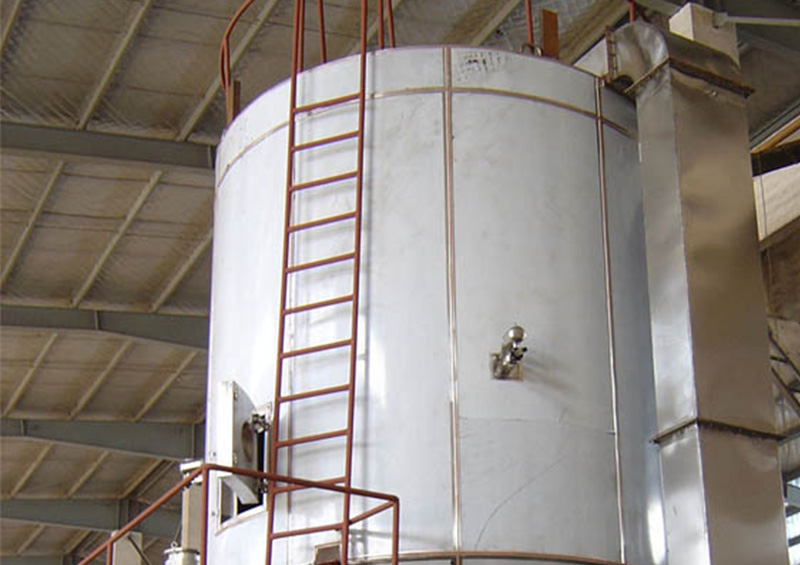
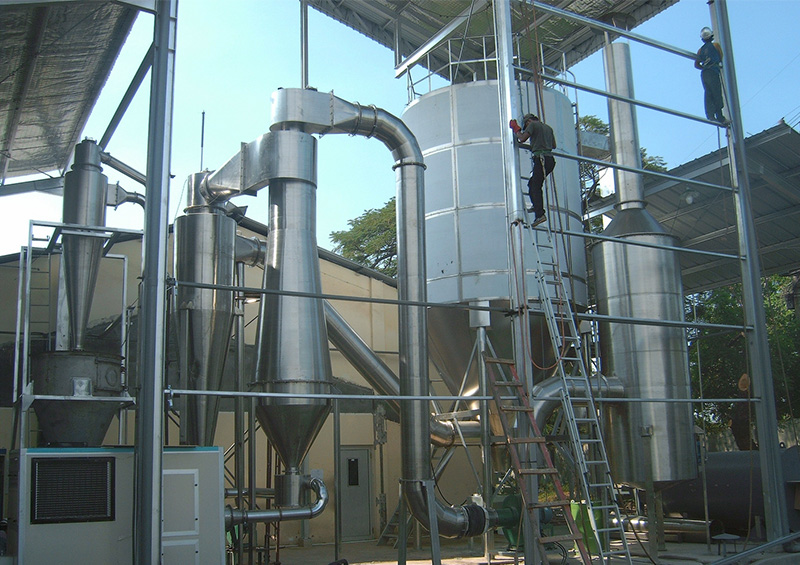
Drying Chamber (Tower): Large chamber where atomized liquid meets the hot drying gas. Contains:
Hot Air/Gas Generation: Heater (electric, gas, steam) producing clean, hot air (or inert gas like N₂).
Air Distribution: Ensures optimal mixing pattern (co-current, counter-current, mixed-flow).
Particle Separation System: Recovers dry powder from the exhaust gas:
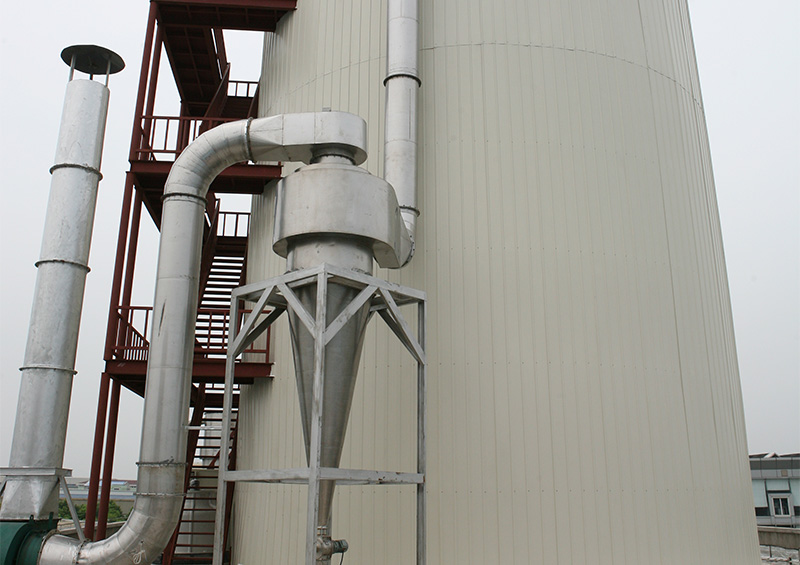
Cyclone Separators: Centrifugal force separates most dry particles. Most common.
Bag Filters: Capture finer particles (esp. < 5-10 microns).
Electrostatic Precipitators: For ultrafine particles (<1 micron).
Wet Scrubbers: For hazardous materials or final particle capture.
Exhaust System: Fan or blower removing moist exhaust gas, often with heat recovery systems.
Powder Handling System: Collects, cools (fluid bed), transports, and packages the dry product.

How Does a Spray Dryer Work? A Step-by-Step Breakdown:
Feed Preparation: The liquid feed (solution, slurry, emulsion) is prepared and optionally pre-concentrated (e.g., via evaporation). It must be pumpable and homogeneous.
Atomization: The feed is pumped into the drying chamber and atomized into a spray of billions of fine droplets using an atomizer. Key principle: Increased surface area drastically speeds up drying.
Drying Gas Contact: Simultaneously, heated dry air or inert gas (typically 150°C - 300°C, sometimes much higher or lower) enters the drying chamber. The gas flow direction relative to the atomized spray is crucial:
Co-current Flow (Most Common for Heat-Sensitives): Hot gas & droplets enter the top of the chamber together. Droplet surface dries rapidly while core remains cooler. Final particle temp is below outlet gas temp. Mild drying.
Counter-current Flow: Hot gas enters the bottom, droplets the top. Particles undergo longer heat exposure, suitable for heat-stable materials requiring low final moisture (e.g., detergents, ceramics). Particle temp approaches inlet gas temp.
Mixed-Flow: Combination of co- and counter-current patterns (e.g., spray from top, gas from top & bottom). Offers flexibility.
Moisture Evaporation: Intense heat and mass transfer occurs as hot gas envelops the droplets. Surface moisture evaporates instantly.
Constant Rate Period: Liquid rapidly evaporates from the droplet surface while it remains saturated. Droplet temperature is near the drying gas's wet-bulb temperature (relatively low, critical for heat-sensitives).
Falling Rate Period: As moisture reduces, evaporation slows and moves inward. A semi-permeable outer "skin" or porous structure forms around the particle core. Temperature rises towards the outlet gas temperature.
Particle Formation: As moisture evaporates, dissolved solids precipitate or suspended particles consolidate, forming dry particles. Morphology depends on feed composition and drying conditions (hollow spheres, dense particles, agglomerates).
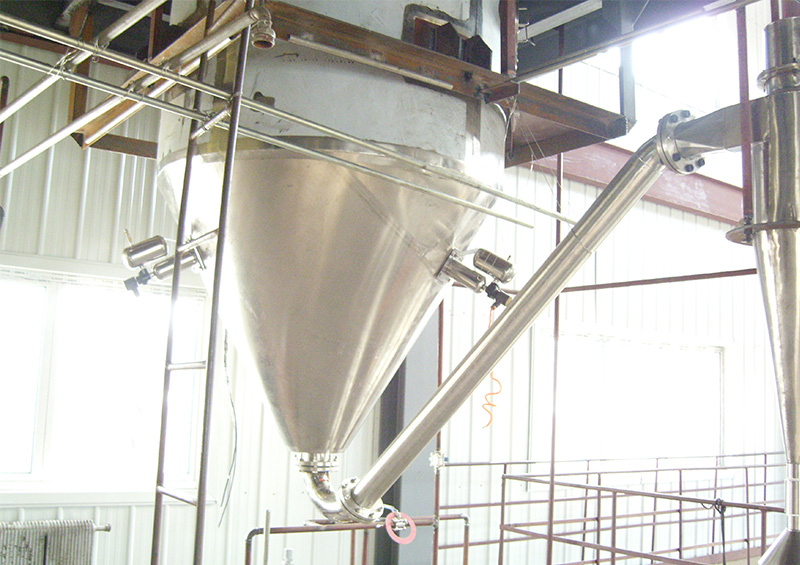
Particle Separation: The now dry powder particles, carried by the exhaust gas, are separated using cyclones, bag filters, etc. Larger particles often fall directly to the chamber cone.
Powder Recovery & Cooling: Separated powder is collected, typically cooled immediately (e.g., via integrated external or integrated cooling fluid bed) to prevent caking and protect heat-sensitive components.
Exhaust Gas Release: The moist, cooled exhaust gas passes through final filters (if needed) and is vented. Modern systems incorporate heat recovery (e.g., pre-heating incoming fresh air) for efficiency.

Diverse Applications Across Industries:
Food & Dairy: Milk powder (WMP, SMP, WPC/WPI), infant formula, coffee, tea, eggs, flavors, starch, sweeteners, soup bases, fruit/vegetable powders.
Pharmaceuticals & Biotech: Excipients, APIs, enzymes, probiotics, vaccines, blood plasma, diagnostic materials (aseptic drying common).
Chemicals: Catalysts, detergents, ceramic powders, pigments, dyes, plastics/polymers, fertilizers, mineral concentrates.
Advanced Materials: Nanomaterials, composites, MOFs, battery materials (esp. pilot/research scale).
Other: Textile auxiliaries, wood pulp additives.
Advantages & Limitations:
Advantages | Limitations/Challenges |
✓ Single-step drying process | ✗ High Capital Cost (equipment & installation) |
✓ Continuous operation | ✗ High Energy Consumption (thermal efficiency 40-70%) |
✓ Rapid drying protects heat-sensitives | ✗ Feed Must Be Pumpable/Suspensible |
✓ Excellent Powder Properties | ✗ Potential Product Stickiness/Hygroscopicity |
✓ Scalable (Lab → Large Industrial) | ✗ Product Yield Losses (to exhaust filters, wall deposits) |
✓ Suitable for Aseptic Production | ✗ Potential Fire/Explosion Hazards (powder + O₂) |
✓ Flexibility in Particle Design | ✗ Off-Gas Control (particulates, odors) |
Modern Trends & Innovations:
Energy Efficiency: Advanced heat recovery systems (thermal wheels, heat pumps), hybrid drying (spray + fluid bed).
Advanced Control: AI/ML for real-time optimization of feed rate, temperatures, pressure drops to maximize yield and product specs.
Nanospray Drying: Specialized ultrasonic systems produce nanoparticles/submicron powders for pharma/nanotech.
Improved Particle Engineering: Novel atomization/coating techniques for complex morphologies, agglomeration control, taste-masking.
Closed-Loop Systems: Using nitrogen gas for sensitive materials and solvent recovery.
Inline Analytics: PAT (Process Analytical Technology) like NIR/Raman for moisture/content monitoring.
Spray drying is a cornerstone technology for modern powder production. Its unique ability to convert diverse liquid feeds into stable, functional powders in a continuous, single-step process makes it indispensable across numerous sectors. While energy-intensive, ongoing innovations in efficiency, control, and particle design ensure its continued relevance in producing essential powders for our daily lives and cutting-edge industries.