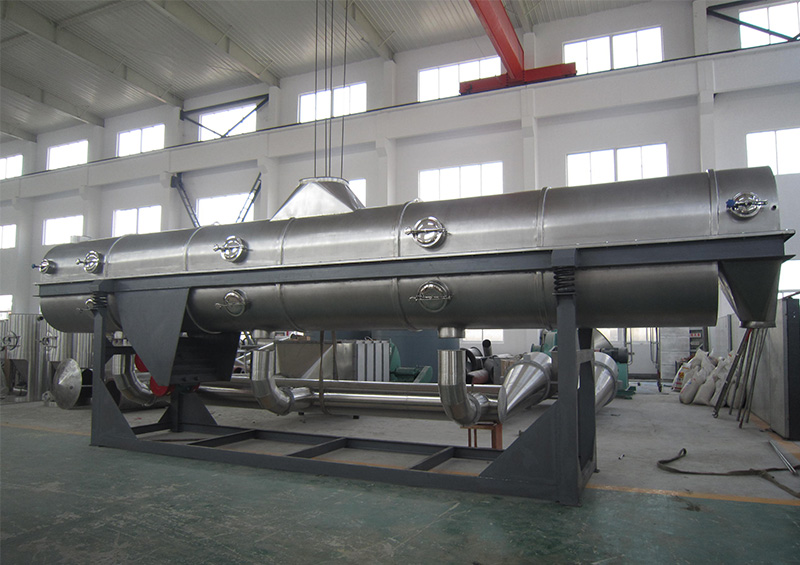






What is fluid bed drying? How does it work?
 Aug 04, 2025|
 View:3738
1. Introduction to Fluid Bed Drying
Fluid bed drying (FBD) is an advanced industrial drying technology that utilizes the principle of fluidization to efficiently remove moisture from powders, granules, and pellets. Unlike conventional drying methods (e.g., tray drying, rotary drying), fluid bed drying ensures uniform heat distribution, rapid moisture removal, and gentle material handling, making it ideal for heat-sensitive products.
This drying technique is widely used across industries, including:
Pharmaceuticals (tablet granules, coated pellets)
Food processing (milk powder, coffee, cereals)
Chemicals & fertilizers (polymer resins, urea granules)
Minerals & ceramics (silica sand, cement)

2. Working Principle of Fluid Bed Drying
2.1 The Fluidization Process
Fluidization occurs when a stream of hot air (or gas) passes upward through a bed of solid particles, lifting and suspending them in a fluid-like state. This enhances heat and mass transfer, ensuring efficient drying.
Key Stages of Fluidization:
Fixed Bed Phase – At low air velocity, particles remain stationary.
Minimum Fluidization Velocity – Airflow reaches a point where particles begin to float.
Bubbling Fluidization – Air bubbles form, improving mixing and heat transfer.
Pneumatic Transport – Excessive airflow carries particles away (used in spray drying).
2.2 Heat and Mass Transfer Mechanism
Hot air passes through the material, transferring heat via convection.
Moisture evaporates from particle surfaces and is carried away by exhaust air.
Continuous agitation prevents clumping and ensures uniform drying.
2.3 Components of a Fluid Bed Dryer
Component | Function |
Air Handling Unit (AHU) | Filters, heats, and controls airflow. |
Product Container | Holds the material to be dried. |
Perforated Distributor Plate | Ensures even air distribution. |
Bag Filter / Cyclone Separator | Removes fine particles from exhaust air. |
Control System | Monitors temperature, airflow, and drying time. |
3. Types of Fluid Bed Dryers
Fluid bed dryers can be categorized based on operation mode, design, and material properties.
3.1 Batch vs. Continuous Fluid Bed Dryers
Type | Description | Applications |
Batch Fluid Bed Dryer | Processes material in fixed quantities. Ideal for small-scale or multi-product drying. | Pharmaceuticals, specialty chemicals. |
Continuous Fluid Bed Dryer | Material is continuously fed and discharged. Suitable for high-capacity production. | Food processing, fertilizers, minerals. |
3.2 Static vs. Vibratory Fluid Bed Dryers
Type | Description | Applications |
Static Fluid Bed Dryer | Relies solely on airflow for fluidization. | Free-flowing powders, granules. |
Vibratory Fluid Bed Dryer | Uses mechanical vibration to assist fluidization. | Sticky or wet materials (e.g., sludge, agrochemicals). |
3.3 Specialized Fluid Bed Systems
Spouted Bed Dryer – For large, dense particles (e.g., seeds, plastics).
Wurster Coater – Combines drying and coating (pharmaceutical pellets).
Multi-Stage Fluid Bed Dryer – Enhances efficiency with sequential drying zones.
4. Industrial Applications of Fluid Bed Drying
4.1 Pharmaceutical Industry
Drying granules before tablet compression.
Coating pellets for controlled drug release.
Lyophilization (freeze-drying) support.
4.2 Food Processing
Milk powder & infant formula production.
Instant coffee & tea drying.
Snack foods & breakfast cereals.
4.3 Chemical & Fertilizer Industry
Drying polymer resins & catalyst beads.
Urea & NPK fertilizer granulation.
4.4 Minerals & Ceramics
Silica gel & zeolite drying.
Cement & clay processing.

5. Advantages of Fluid Bed Drying
✅ Faster drying than tray or oven drying.
✅ Uniform moisture removal due to constant agitation.
✅ Gentle on heat-sensitive materials (e.g., enzymes, probiotics).
✅ Multi-functional (can be used for drying, cooling, and coating).
✅ Scalable from lab-scale to industrial production.
Comparison with Other Drying Methods
Drying Method | Fluid Bed Drying | Tray Drying | Rotary Drying |
Drying Speed | Very fast | Slow | Moderate |
Uniformity | Excellent | Poor | Moderate |
Material Handling | Gentle | Risk of overheating | Abrasive |
Energy Efficiency | High | Low | Moderate |
6. Key Considerations When Selecting a Fluid Bed Dryer
6.1 Material Properties
Particle size & density (affects fluidization behavior).
Moisture content (sticky materials may need pre-treatment).
Heat sensitivity (low-temperature drying for fragile products).
6.2 Production Requirements
Batch vs. continuous processing.
Throughput capacity (kg/hr or tons/day).
6.3 Energy Efficiency & Cost
Heat recovery systems to reduce operational costs.
Electric vs. gas heating options.
6.4 Compliance & Safety
GMP requirements for pharmaceuticals & food.
Explosion-proof designs for flammable materials.
6.5 Maintenance & Cleaning
Ease of disassembly for CIP (Clean-in-Place) systems.
Filter replacement frequency.
7. Future Trends in Fluid Bed Drying
AI & IoT integration for real-time process optimization.
Hybrid drying systems (e.g., microwave-assisted fluid bed drying).
Sustainable energy solutions (solar-assisted drying).
8. Conclusion
Fluid bed drying is a highly efficient, versatile, and scalable drying solution that outperforms traditional methods in speed, uniformity, and material handling. Its applications span pharmaceuticals, food processing, chemicals, and minerals, making it indispensable in modern manufacturing.