





Instant Coffee Production: Equipment, Process, and Global Plant Costs
 Nov 06, 2025|
 View:4630
Instant coffee, a staple in households and offices worldwide, represents a marvel of modern food technology that combines agricultural heritage with industrial precision. This convenient beverage begins its journey as green coffee beans and undergoes a sophisticated transformation into soluble powder or granules. The global instant coffee market has experienced significant shifts in recent years, influenced by supply chain dynamics, climatic conditions, and evolving consumer preferences. This article explores the manufacturing process of instant coffee, the equipment required for production, and the cost considerations for establishing processing plants in major coffee-producing regions including Brazil, Vietnam, Colombia, Kenya, and South Africa. Understanding these elements provides valuable insight into an industry that balances convenience with complexity, where advanced technology meets the challenges of agricultural commodity markets .
1 The Instant Coffee Manufacturing Process
1.1 From Bean to Extract
The production of instant coffee begins with the selection of quality coffee beans, typically Robusta varieties known for their higher caffeine content and stronger flavor, though premium instant coffees may incorporate Arabica beans for a smoother profile . The process initiates with roasting, where green coffee beans are subjected to temperatures between 180°C to 240°C (356°F to 464°F) to develop their characteristic aroma and flavor through Maillard reactions . Following roasting, the beans are cooled rapidly to prevent overcooking, then ground to a specific particle size optimized for extraction.
The next stage involves industrial-scale brewing, where ground coffee undergoes extraction in large percolation columns using hot water. This process dissolves the soluble compounds from the coffee grounds, resulting in a concentrated coffee extract containing approximately 15-30% coffee solids. The extraction is typically performed in a series of 8 cylindrical containers where hot water at about 190°C circulates continuously through the coffee grounds. Following extraction, the coffee solution is concentrated through evaporation or freezing to achieve a concentration of 50-60% solids before the drying process, making it more efficient to dry while preserving the coffee's volatile aromatic compounds.
1.2 Drying Methods: Spray Drying vs. Freeze Drying
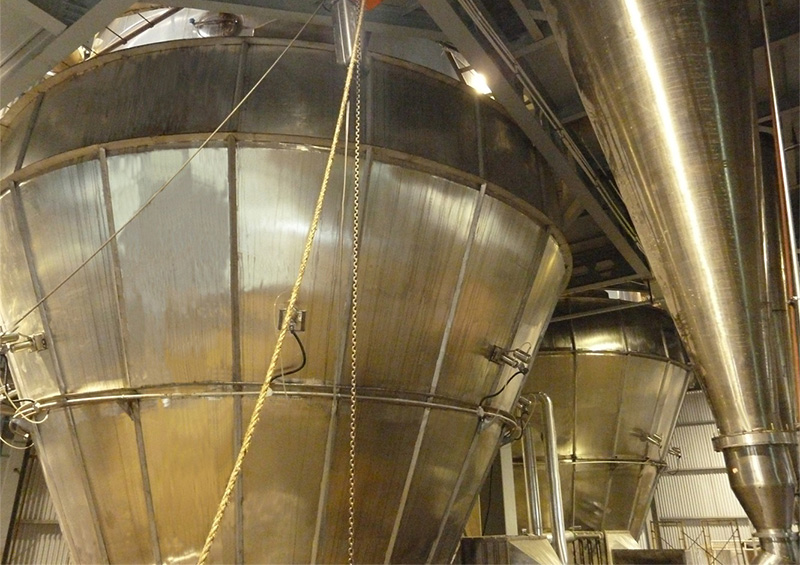
The core differentiation in instant coffee production lies in the drying method employed. Spray drying is a cost-effective approach where concentrated coffee extract is atomized into a chamber with hot air reaching up to 250°C. As the fine droplets descend, water evaporates, leaving behind fine spherical powder particles with a density of approximately 0.22 g/cm³. This method is efficient for mass production but produces particles that are often too fine for ideal consumer use, requiring further agglomeration where fine powder is re-wetted and passed through steam to form larger granules that dissolve more readily.
Freeze drying (lyophilization) is a premium alternative that better preserves the coffee's delicate flavors and aromas. In this process, the coffee extract is first frozen into slabs, which are then broken into granules. These frozen granules are placed in a vacuum chamber where ice sublimates directly from solid to gas without passing through a liquid phase . Freeze-dried coffee typically exhibits better aroma retention and is often marketed as a premium product compared to spray-dried varieties. The low-temperature drying environment maximizes aroma retention, and the size of the granules can be controlled through the degree of size reduction and classification applied to the frozen extract.
1.3 Aromatization and Packaging
A critical step in high-quality instant coffee production is aromatization, where volatile aromatic compounds lost during processing are recovered and reintroduced to the final product. This process involves separating aromatic elements during extraction, concentrating them, and then spraying them back onto the dried coffee particles. This technique significantly enhances the final product's sensory profile, making it closer to freshly brewed coffee in aroma and taste.
The final stage involves packaging the instant coffee in moisture-proof and airtight containers, often with nitrogen flushing to prevent oxidation and extend shelf life. Instant coffee is typically packaged in glass jars, foil packets, or single-serve sachets, with strict quality controls monitoring moisture content to prevent clumping or spoilage.

2 Production Equipment Requirements
2.1 Core Processing Machinery
Establishing an instant coffee production line requires significant investment in specialized equipment. The core machinery includes roasting ovens that operate at temperatures between 180°C-200°C with batch capacities of approximately 250kg , grinding equipment with roller mills for crushing roasted beans , and extraction systems consisting of multiple cylindrical containers where the actual brewing process occurs .
The drying equipment varies depending on the chosen method. Spray dryers come in various capacities, with standard models including YPG-25 to YPG-300, indicating their water evaporation capacity in kg/h . These systems feature drying tower diameters ranging from 1200mm to 3200mm, with overall dimensions varying accordingly . For freeze-drying systems, more sophisticated equipment is required to handle the freezing and sublimation processes under vacuum conditions .
Additional essential equipment includes concentrators (double efficiency concentrators that increase solid content from 12-15% to 50% ), filtration systems, and aroma recovery units that capture and reintroduce volatile compounds . Modern plants also incorporate automated control systems with PLC+HMI interfaces for precise process management .
2.2 Auxiliary Systems and Specifications
Beyond the core processing equipment, instant coffee production requires substantial auxiliary systems. CIP (Cleaning-In-Place) systems are essential for maintaining hygiene standards without disassembly, using effective volumes of approximately 50L for acid, alkali, and water tanks. Boiler systems provide necessary steam and heating, capable of operating on various fuels including natural gas, diesel, or combustible waste materials.
The electrical requirements for a medium-capacity plant typically reach 25.5kW, with control systems housed in stainless steel cabinets rated IP65 for protection. Material handling equipment includes vibrating screens, Roots fans for bean transportation, and cooling systems with plate screens. Most equipment components that contact the product are constructed from AISI 304 or 316L stainless steel to meet food safety standards.
Complete production lines are often custom-designed based on capacity requirements, which can range from small-scale operations (10 kg/h) to large industrial plants (800 kg/h or more). The product collection rate typically reaches 95-99.9%, depending on the product properties and system configurations.
3 Regional Production Cost Analysis
3.1 Brazil and Vietnam: The Global Leaders
Brazil, as the world's largest shipper of instant coffee, benefits from a robust infrastructure and technological advantages in coffee production. The country's instant coffee exports reached a record 4 million bags in 2019, surpassing the previous record of 3.9 million bags in 2016 . Brazilian producers have rapidly adopted new technology, with robusta yields reaching 200-300 bags per hectare in Rondônia state due to new varieties and ample irrigation. This efficiency, combined with currency advantages, has given Brazilian instant coffee a significant cost advantage of approximately 15% over Vietnamese prices.
Vietnam, the world's largest producer of robusta beans, has faced production challenges due to climatic conditions. Severe drought linked to the El Niño phenomenon reduced yields significantly, with farmers unable to deliver between 150,000-200,000 tons of contracted beans during the 2023-2024 harvest . This supply crunch has driven robusta prices to multi-year highs, increasing production costs for Vietnamese instant coffee plants. Despite these challenges, Vietnam remains a major production hub, though with older tree populations yielding approximately 50 bags per hectare, significantly below Brazilian efficiency levels.
3.2 Colombia, Kenya, and South Africa: Regional Producers
Colombia, known primarily for high-quality Arabica beans, has developed a specialty instant coffee segment. Products like Café Saint-Henri's instant coffee sourced from Nariño department demonstrate how producers can command premium prices (1.22 USD/lb) by emphasizing origin specificity and quality . While Colombian instant coffee production may have higher bean costs, the potential for value-added products creates different economic dynamics compared to mass-market producers.
Kenya's instant coffee production costs are influenced by its focus on quality Arabica beans, though specific cost data for Kenyan plants is limited in the search results. Like Colombia, Kenya likely positions itself in the premium segment where bean quality outweighs pure cost considerations.
South Africa represents a consumption market heavily dependent on imports, particularly affected by global price fluctuations. South African consumers have faced instant coffee price increases of 18% annually in May 2024, far exceeding the general inflation rate of 5.2% . Since 2017, the cost of a 250-gram jar of instant coffee has increased by 82% in South Africa, reflecting both global market trends and regional economic factors . Establishing production facilities in South Africa would involve navigating these import dependencies while potentially reducing costs for regional distribution.
4 Market Dynamics and Economic Considerations
4.1 Global Price Influences
The instant coffee market has experienced significant price volatility in recent years. Robusta bean prices, crucial for instant coffee production, increased by more than 50% in 2024, reaching their highest levels in decades. This surge was largely driven by weather-related production issues in Vietnam, the world's largest robusta producer, where drought conditions reduced output . Arabica prices have also risen, reaching $3.44 per pound in 2024, an increase of over 80% year-on-year.
These commodity price increases directly impact production costs, though the effect on consumer prices is moderated by other factors. Raw coffee beans typically represent approximately 25% of the final cost of instant coffee, with the remainder accounted for by processing, packaging materials, labor, transportation, and energy. Therefore, a 10% increase in bean costs translates to only about a 2.5% increase in the final product price. This cost structure provides some buffer for producers but still creates significant pressure in a competitive market.
4.2 Strategic Production Decisions
Companies are adapting to market dynamics through strategic sourcing and production adjustments. Nestlé, for example, has responded to Vietnamese supply issues by diversifying its sourcing to include more beans from Brazil, Indonesia, and India to maintain supply to its global factories . Similarly, coffee blends are increasingly incorporating higher proportions of robusta beans—sometimes reaching 50-80% of mixes compared to the traditional 20%—to manage costs while maintaining product affordability.
The choice between spray drying and freeze drying also represents a significant economic decision. While freeze drying preserves more aroma and flavor, it requires more sophisticated equipment and higher energy inputs. Spray drying remains more economical for high-volume production, though agglomeration processes may be needed to improve solubility and consumer appeal. The selection of technology thus depends on target markets, quality positioning, and production scale.
The production of instant coffee involves a sophisticated manufacturing process that transforms coffee beans into soluble forms through extraction and drying technologies. Equipment requirements range from basic roasting and grinding machinery to advanced extraction systems and specialized dryers, with costs varying significantly based on capacity and technology level. Regional production economics differ markedly, with Brazil benefiting from scale and efficiency, Vietnam facing climate challenges despite its robusta specialization, and countries like Colombia focusing on premium segments. As global coffee markets continue to experience volatility due to climatic factors and supply chain pressures, instant coffee producers must balance cost considerations with quality objectives across different geographical contexts. The industry's future will likely involve continued technological refinement, strategic sourcing adaptations, and potentially increased localization of production in key consumption markets to navigate the complex interplay of agricultural, industrial, and economic factors that define this global commodity.