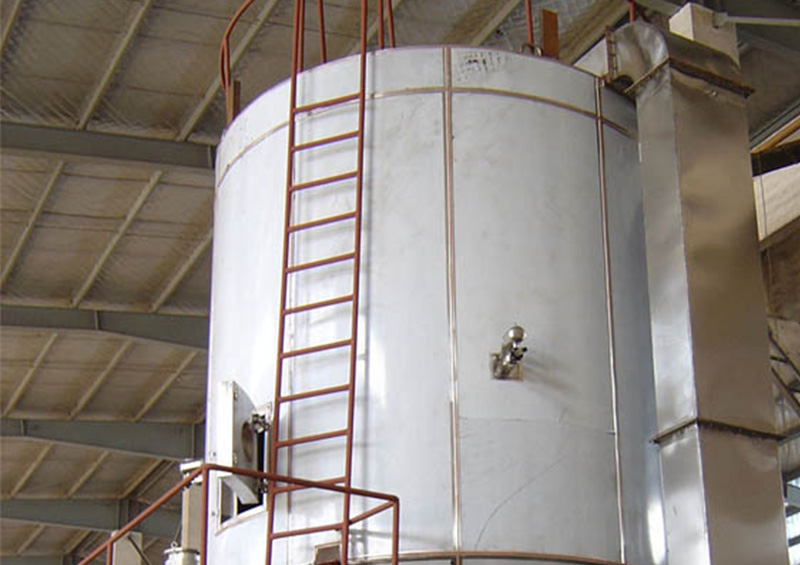






What is the application of spray drying in pharmaceutical industry?
 Nov 07, 2024|
 View:2599
Spray drying in the pharmaceutical industry is a versatile and widely applied technique that has revolutionized the way drugs are formulated and delivered. This process involves converting solutions, suspensions, or emulsions into dried powders in a single step by atomizing the feedstock into a hot drying gas medium. Here are some key applications and benefits of spray drying in the pharmaceutical industry:
1. Amorphous Solid Dispersions
One of the most significant applications of spray drying in the pharmaceutical industry is the production of amorphous solid dispersions (ASDs). These dispersions are used to improve the solubility and bioavailability of poorly water-soluble drugs. By spray drying a drug with a polymer, a stable amorphous dispersion can be created, which enhances the dissolution rate and, consequently, the bioavailability of the active pharmaceutical ingredient (API).

2. Taste Masking
Spray drying is also used for taste masking, particularly for inhaled drugs like powder insulin and controlled-release formulations. This technique allows manufacturers to encapsulate the API and biodegradable excipients, thereby masking the taste without compromising drug release.
3. Modified Release Formulations
Spray drying enables the creation of sustained or modified release formulations by encapsulating the drug. This can be beneficial for various drug classes, reducing dosage requirements and minimizing side effects by smoothing out peaks in drug concentration.
4. Aseptic Manufacturing
Spray drying offers advantages over other aseptic manufacturing techniques, such as lyophilization. It provides greater control over the process and the final product form, which is particularly useful for drugs requiring aseptic manufacturing. The API is combined with excipients of the same particle size distribution, creating sterile particles without the risk of contamination.
5. Production of Fine Powders
Spray drying is used to produce fine powders, which are essential for drugs that require precise dosing and uniformity. These powders can be used in various drug delivery systems, including inhalable drugs and microcapsules.
6. Improvement of Bioavailability
Many therapeutic compounds are stable in crystalline form but have poor aqueous solubility and dissolution rates, leading to reduced bioavailability. Spray drying can create stable, amorphous dispersions that improve the dissolution rate and, thus, the bioavailability.

7. Encapsulation and Protection
Spray drying is used to encapsulate drugs, protecting them from environmental factors and enhancing their stability. This is particularly useful for temperature-sensitive and difficult-to-crystallize APIs.
8. Inhalable Drugs
The production of inhalable drugs, such as inhaled insulin, has been made possible through spray drying. This technique allows for the creation of powders that can be inhaled, providing a non-invasive method of drug delivery.
9. Particle Engineering
Spray drying is used as a particle-engineering platform, allowing for the manipulation and control of particle properties such as size distribution, shape, density, flowability, moisture content, crystallinity, and dispersibility.
10. Cost and Time Efficiency
Compared to other drying techniques, spray drying offers significant time and cost savings, especially in processing large biomolecules. It is a low-cost, scalable, and consistent technique for formulating low solubility small molecule drugs via preparing amorphous solid dispersions.
In conclusion, spray drying in the pharmaceutical industry has become an indispensable technique, offering numerous advantages such as improved bioavailability, taste masking, modified release, aseptic manufacturing, and particle engineering. As the industry continues to evolve, spray drying is likely to play a crucial role in the development of new drug delivery systems and formulations.