





How the different types of industrial spray dryers work
 Dec 28, 2022|
 View:2469
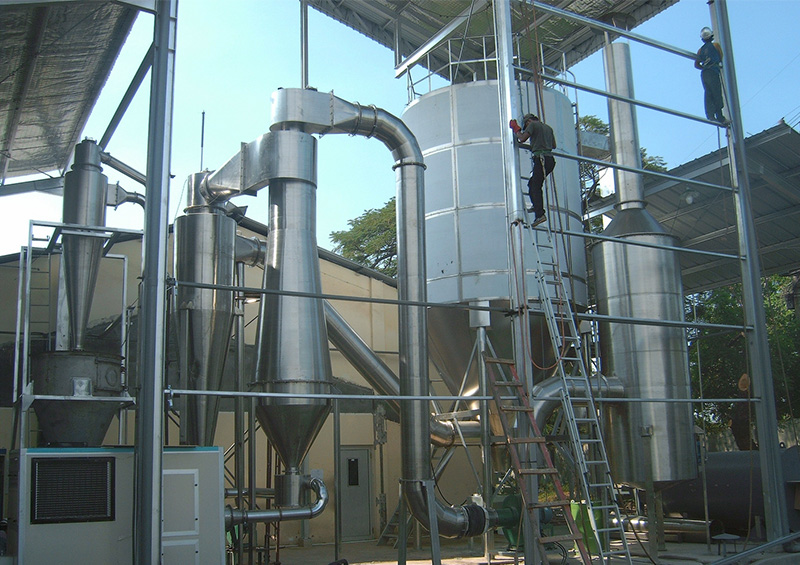
Industrial spray dryers are devices that can dry and granulate at the same time. They are used for drying heat-sensitive liquids, suspensions, and viscous liquids, as well as fuels, intermediates, soap powders, inorganic salts, etc. The liquid is sprayed into a mist with special equipment and is dried in contact with hot air. What is the principle of operation of the different types of industrial spray dryers?
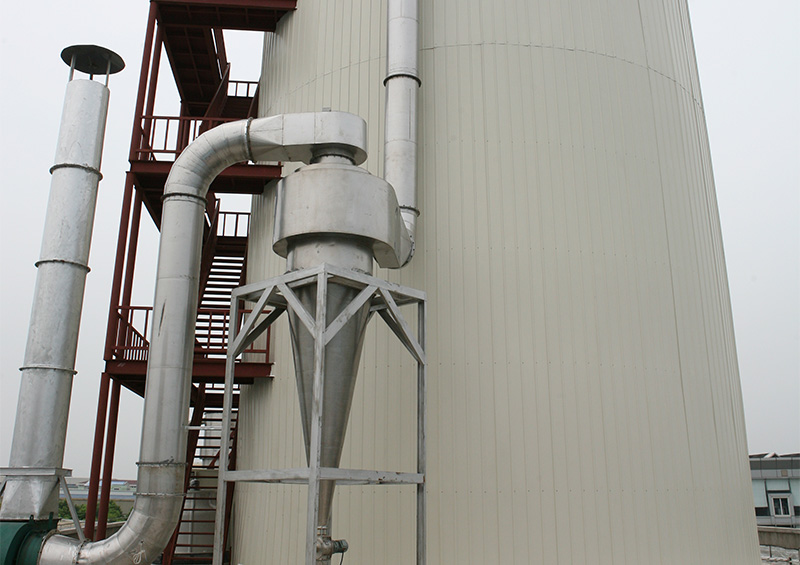
The principle of industrial spray dryers:
Industrial spray dryers are drying methods that use an atomizer to disperse the raw liquid into droplets and dry the droplets with hot gas (air, nitrogen, or superheated steam) to obtain a product. The raw liquid to be spray-dried can be a solution, emulsion, suspension or molten liquid, or paste. The dried product can be made into powder, granules, hollow balls, or pellets as required. Liquid atomization The atomizer, which disperses the material liquid into droplets, is a key part of spray drying.
Principle of the pressure industrial spray dryer:
Pressure atomizer: A high-pressure pump is used to obtain high pressure for the liquid. As the high-pressure liquid passes through the nozzle, the pressure energy is converted into kinetic energy and dispersed as droplets when sprayed at high speed.
Principle of the airflow industrial spray dryer:
Airflow atomizer: compressed air or steam is ejected from the nozzle at a very high velocity (≥ 300 m / s). The frictional force generated by the velocity difference between the gas and liquid phases splits the liquid into droplets.
Principle of the centrifugal spray dryer:
Using a rotary atomizer: the material liquid is thrown off the edge of the disc and atomized by centrifugal force in a high-speed rotating disc (circumferential speed of 90-160 / ms).
The above is the working principle of the different types of industrial spray dryers, we hope to help you better understand our products, if you have other questions or needs, you can contact us directly.
Core Design Principles for Industrial Scale
Massive Drying Chambers
Towers reach 5–25+ meters in height and 3–10+ meters in diameter. Engineering challenges include:Structural integrity to withstand high-temperature gas flows
Wall deposit minimization (sloped surfaces, air sweeps)
Material compatibility (304/316L stainless steel, nickel alloys, ceramic linings)
High-Capacity Atomization
| Atomizer Type | Industrial Scale | Typical Use Cases |
| Rotary Disk | Up to 60,000 RPM, 200+ kg/hr | Dairy, ceramics, high-viscosity feeds |
| Multi-Nozzle Arrays | 4–16 pressure nozzles | Pharmaceuticals, uniform particle size |
| Two-Fluid Nozzles | Fine powders < 50 microns | Catalysts, APIs |
3. Advanced Heat Systems
Direct gas/fuel burners (natural gas, diesel)
Thermal oil heaters for temperatures >300°C
Inert gas loops (N₂) for solvents/oxygen-sensitive products