





What is the principle of the spray dryer?
 Jun 25, 2025|
 View:2443
The spray dryer is a vital piece of equipment in numerous industries, including food, pharmaceuticals, chemicals, and ceramics. Its primary function is to convert liquid formulations into dry powder form efficiently and with high precision. Understanding the principle behind a spray dryer is crucial for appreciating its capabilities and the wide - ranging applications it serves.
Basic Concept
At its core, the spray dryer operates on the principle of atomization and rapid heat and mass transfer. The process begins with the introduction of a liquid feed, which can be a solution, suspension, or emulsion, into the spray dryer. This liquid is then atomized into tiny droplets. Atomization is a critical step as it greatly increases the surface area of the liquid, exposing it more effectively to the drying medium, usually hot air.
Atomization Process
There are several common methods of atomization used in spray dryers. One of the most widely employed techniques is pressure nozzle atomization. In this method, the liquid is forced through a small orifice under high pressure. As the liquid exits the nozzle, the pressure drop causes it to break up into fine droplets. The size of these droplets can be controlled to some extent by adjusting the pressure and the design of the nozzle.
Another popular atomization method is two - fluid nozzle atomization. Here, the liquid is mixed with a compressed gas, typically air. The interaction between the liquid and the gas stream results in the formation of small droplets. This method offers flexibility in terms of adjusting the droplet size by varying the ratio of liquid to gas and the gas pressure.
Rotary atomization is also used in some spray dryers. A rotating disc or wheel is immersed in the liquid feed. As the disc spins at high speed, the liquid is thrown off the edge due to centrifugal force, forming a thin film that then disintegrates into droplets. The rotational speed and the design of the atomizer influence the droplet size distribution.

Heat and Mass Transfer
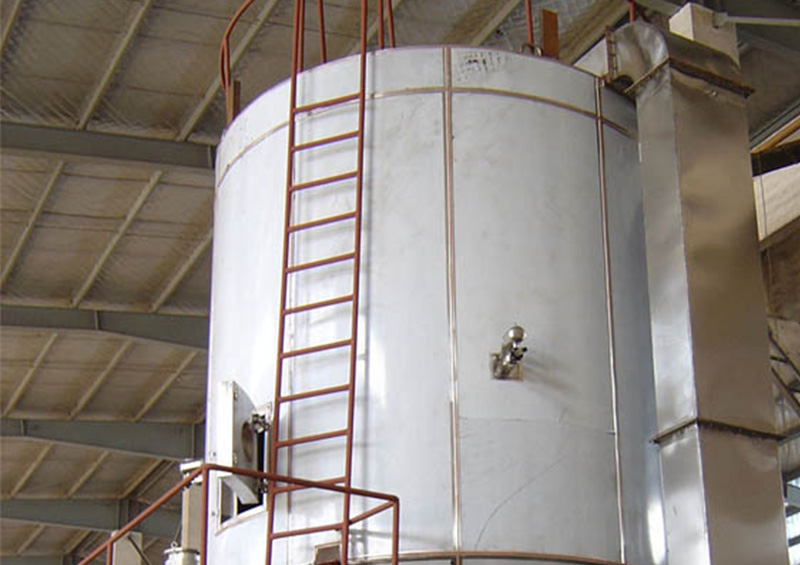
Once the liquid is atomized into droplets, it enters a drying chamber where hot air is introduced. The hot air serves two main purposes: spray dryer provides the heat required for evaporation and it carries away the moisture - laden air. The high surface area of the atomized droplets allows for rapid heat transfer from the hot air to the liquid. As the heat is absorbed, the water or solvent in the liquid starts to evaporate.
This evaporation process is a mass transfer phenomenon. The moisture within the droplets diffuses to the surface and then into the surrounding hot air. The rate of evaporation depends on factors such as the temperature difference between the air and the droplets, the humidity of the air, and the surface area of the droplets. As the moisture evaporates, the droplets shrink, and solid particles are formed.
Particle Formation and Collection
The solid particles continue to move through the drying chamber, with further drying occurring as they interact with the hot air. The residence time of the particles in the drying chamber is carefully controlled to ensure that the desired moisture content is achieved. Once the particles are sufficiently dry, they are carried out of the drying chamber by the exhaust air.
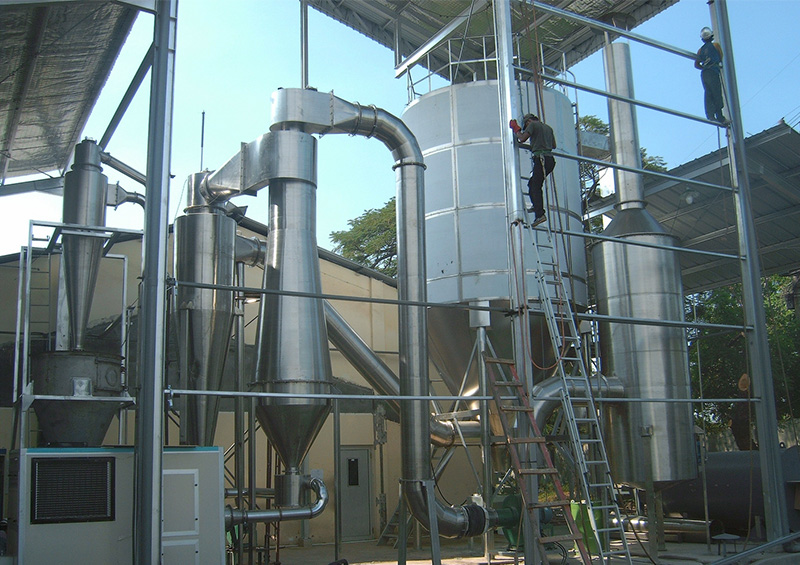
To separate the dried powder from the exhaust air, a collection system is employed. Cyclone separators are commonly used for this purpose. The centrifugal force generated within the cyclone causes the heavier powder particles to be separated from the air stream and collected at the bottom of the cyclone. Fine particles that may still be entrained in the air can be further removed using bag filters or electrostatic precipitators.
In summary, the principle of the spray dryer revolves around atomizing a liquid into small droplets to increase the surface area for efficient heat and mass transfer. Through the interaction with hot air, the moisture in the droplets evaporates, leading to the formation of dry powder particles, which are then collected for further use. This versatile technology continues to be a cornerstone in various industries due to its ability to produce high - quality powders with controlled properties.