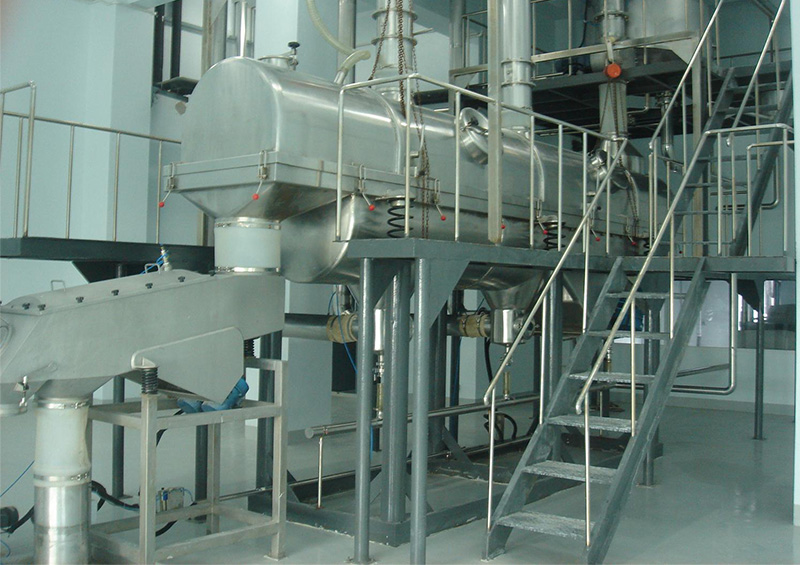






How does a milk dryer work?
 Jun 03, 2025|
 View:5096
Milk drying is a dehydration process that removes ~87% of water from liquid milk, converting it into a shelf-stable powder. The primary methods include spray drying, freeze drying, drum drying, and vacuum drying, each with distinct mechanisms and advantages. Below is a detailed breakdown of these processes.
Spray Drying (Most Common Method)
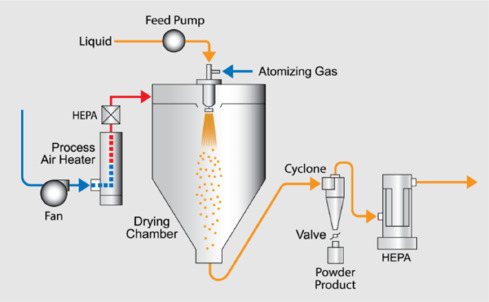
Principle: Liquid milk is atomized into fine droplets and exposed to hot air, causing instantaneous water evaporation.
Steps:
Pre-concentration: Milk is first concentrated via evaporation (removing ~60% water) to reduce energy costs.
Atomization: The concentrated milk is sprayed through a high-speed centrifugal nozzle or pressure nozzle, creating droplets of 10–200 µm.
Drying Chamber: Hot air (150–300°C) flows co-currently or counter-currently, evaporating water in seconds. The droplets dry into powder before reaching the chamber bottom.
Separation: Powder is collected via cyclones or bag filters, while exhaust air (now cooler) is expelled.
Advantages:
High throughput (up to 10,000 L/h in industrial units).
Preserves nutrients and solubility due to rapid drying.
Limitations:
High energy consumption (~1.7 kg steam/kg water evaporated).
Equipment costs are significant.
Industrial Use: Dominates dairy industry for bulk milk powder production.
Freeze Drying (Lyophilization)
Principle: Milk is frozen, then water sublimates directly from ice to vapor under vacuum.
Steps:
Freezing: Milk is cooled to -40°C to -50°C to form solid ice crystals.
Primary Drying: In a vacuum chamber, pressure is reduced (<1 atm), and slight heat is applied to sublimate ice.
Secondary Drying: Residual moisture is removed at slightly higher temperatures.
Advantages:
Maximizes nutrient/flavor retention (ideal for premium products).
Powder rehydrates exceptionally well.
Limitations:
Slow (hours to days) and expensive due to vacuum/freezing requirements.
Applications: Specialty products like infant formula or high-value dairy powders.
Drum Drying (Roller Drying)
Principle: Milk is spread as a thin film on heated rotating drums, drying via conduction.
Steps:
Application: Liquid milk is fed onto steam-heated drums (120–170°C).
Drying: As drums rotate, the film dries within 10–300 seconds and is scraped off as flakes/powder.
Advantages:
Cost-effective for large-scale production.
Imparts a toasted flavor (desirable in some products).
Limitations:
Coarser powder with lower solubility.
Heat-sensitive nutrients (e.g., vitamins) may degrade.
Use Cases: Instant beverages or baked goods where texture is less critical.
Vacuum Drying
Principle: Milk is dried at low pressure, lowering the boiling point of water to preserve heat-sensitive compounds.
Steps:
Vacuum Chamber: Milk is placed in a sealed chamber where pressure is reduced to ~0.1 atm.
Gentle Heating: Water evaporates at 30–60°C (vs. 100°C at atmospheric pressure).
Advantages:
Energy-efficient and gentle on nutrients.
Limitations:
Slower than spray drying.
Applications: Pharmaceuticals or niche dairy products.
Key Considerations in Milk Drying
Pre-treatment: Pasteurization and filtration ensure safety and remove impurities.
Energy Efficiency: Multi-stage evaporators reduce spray drying costs.
Quality Control: Parameters like inlet/outlet air temperature (±1°C precision) are critical.
Spray drying remains the industry standard for milk powder production due to its speed and scalability, while freeze drying excels in premium applications. Drum and vacuum drying offer niche advantages but face trade-offs in cost or product quality. Advances in automation (e.g., PID temperature control) and hybrid systems continue to optimize these processes for global dairy demands.