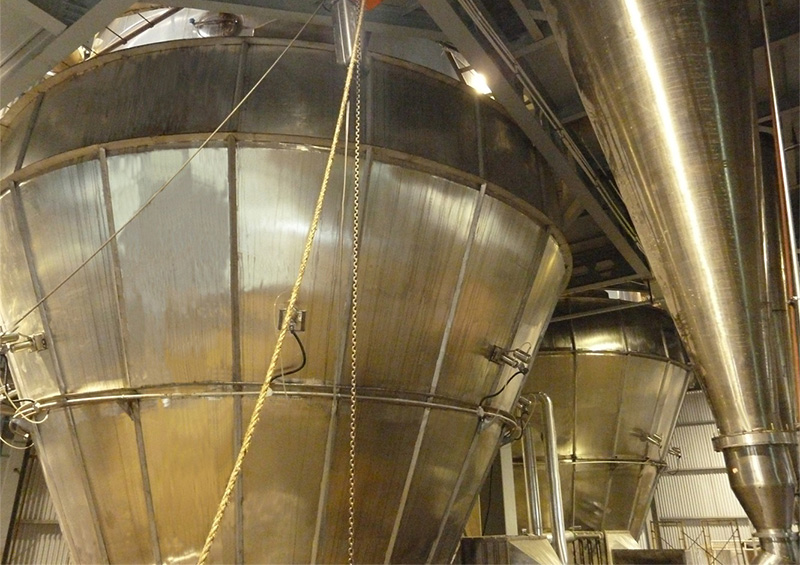






Instant Coffee Powder Spray Dryer Technology,Process
 Aug 13, 2025|
 View:3614
Instant coffee, a popular beverage choice for its convenience and quick preparation, is produced through a dehydration process that converts brewed coffee into soluble powder or granules. Among the various drying techniques, spray drying is one of the most widely used methods in the food industry for producing instant coffee powder. This article explores the coffee spray drying process, its advantages, working principles, and applications in the instant coffee industry.
1. What is Spray Drying?
Spray drying is a continuous dehydration process that transforms liquid feed (such as coffee extract) into a dry powder by atomizing it into fine droplets and exposing them to hot air. The rapid evaporation of moisture leaves behind fine, free-flowing particles that can be easily reconstituted in water.
Key Components of a Spray Dryer
A typical spray dryer for instant coffee production consists of:
Feed System – Pumps coffee extract into the drying chamber.
Atomizer – Breaks the liquid into tiny droplets (rotary disk, pressure nozzle, or two-fluid nozzle).
Drying Chamber – Hot air evaporates moisture from the droplets.
Air Heater – Provides the necessary heat for evaporation.
Cyclone Separator – Separates dried powder from the exhaust air.
Powder Collection System – Collects the final product for packaging.
2. Spray Drying Process for Instant Coffee
Step 1: Coffee Extraction
Coffee beans are roasted, ground, and brewed to produce a concentrated liquid extract.
The extract is filtered to remove insoluble solids, leaving a clear coffee solution.
Step 2: Pre-Concentration (Optional)
The liquid coffee may undergo evaporation to increase solids concentration (typically 30-50% solids) before spray drying.
This step reduces energy consumption during drying.
Step 3: Atomization
The coffee extract is pumped into the drying chamber and atomized into fine droplets (20-180 microns).
Rotary atomizers (high-speed spinning disks) or nozzle atomizers (pressure or pneumatic) are commonly used.
Step 4: Drying
Hot air (150-250°C) is introduced into the chamber, instantly evaporating moisture from the droplets.
The drying process takes only a few seconds, preserving coffee flavor and aroma.
Step 5: Powder Separation & Collection
The dried coffee particles are separated from the exhaust air using a cyclone or bag filter.
The powder is cooled and packaged in moisture-proof containers.

3. Advantages of Spray Drying for Instant Coffee
High Efficiency – Continuous operation allows large-scale production.
Preservation of Quality – Rapid drying minimizes thermal degradation of flavors.
Uniform Particle Size – Produces fine, consistent powder for better solubility.
Flexibility – Can handle different coffee concentrations and formulations.
Low Microbial Risk – High temperatures reduce bacterial contamination.
Comparison with Freeze Drying
While freeze drying (lyophilization) retains more aroma, it is more expensive and slower than spray drying. Spray drying is preferred for cost-effective mass production.
4. Challenges and Solutions in Spray Drying Coffee
A. Loss of Volatile Aromas
Solution: Encapsulation techniques or adding aroma back after drying.
B. Powder Stickiness (Hygroscopicity)
Solution: Adding anti-caking agents (e.g., maltodextrin) or agglomeration.
C. Energy Consumption
Solution: Using heat recovery systems or multi-stage drying.
D. Particle Size Control
Solution: Adjusting atomizer speed, feed rate, and air temperature.
5. Applications Beyond Instant Coffee
Spray drying is also used for:
Milk powder
Tea extracts
Fruit juices
Pharmaceutical powders
6. Future Trends in Spray Drying Technology
Energy-Efficient Designs – Advanced heat recovery systems.
Nano Spray Dryers – For ultra-fine powders in specialty coffee.
Smart Control Systems – AI-based optimization of drying parameters.
The spray drying process is a key technology in instant coffee production, offering high efficiency, scalability, and cost-effectiveness. While it has some limitations in aroma retention, ongoing advancements continue to improve powder quality. As demand for instant coffee grows globally, spray drying remains the dominant method for producing high-quality soluble coffee powder.