


Open Cycle vs Closed Loop Spray Dryer: How to Choose the Right Drying System
 Oct 28, 2026|
 View:8
When industrial manufacturers evaluate spray drying equipment, one of the most important early decisions is whether to use an open cycle spray dryer or a closed loop spray dryer. Both systems follow the same basic principle—atomizing a liquid feed into fine droplets and removing moisture with hot gas—but they differ sharply in drying medium, safety design, solvent handling, operating cost, and final powder quality.
At Changzhou Jinqiao, we design and manufacture industrial spray drying systems for food, dairy, ceramics, dyestuffs, chemicals, herbal extracts, and high-value specialty materials. In this guide, we break down the differences between open cycle and closed loop spray dryers, explain when each system is the right choice, and help you avoid the most common selection mistakes.
1. What Is an Open Cycle Spray Dryer?
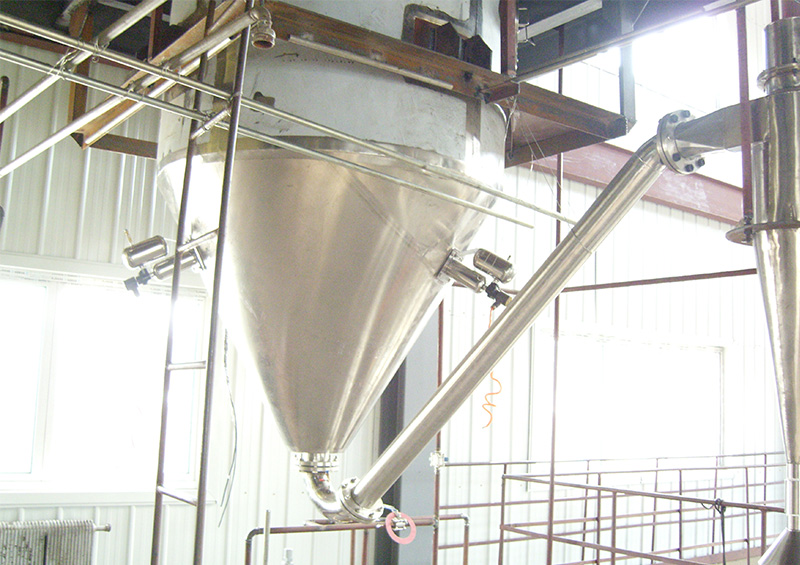
An open cycle spray dryer is the most common configuration in industrial powder production. Ambient air is filtered, heated, and introduced into the drying chamber. The atomized feed meets the hot air, moisture evaporates, and the dried powder is separated by cyclone, bag filter, or a combined collection system. The exhaust gas is then discharged to the atmosphere after dust control.
Typical Process Flow
Fresh air intake and filtration
Air heating by gas, steam, electricity, or thermal oil
Liquid feed atomization through rotary atomizer or pressure nozzle
Droplet drying inside the chamber
Powder separation and collection
Exhaust air released after environmental treatment
Best Suited For
Open cycle systems are ideal for water-based feeds, including:
Milk powder, whey, and protein blends
Food colors and beverage extracts
Ceramic slurries and inorganic salts
Detergents and zeolite products
Water-based dyestuffs and pigments
Many standard chemical and agricultural formulations
Because the evaporated vapor is mainly water, the process is simpler, safer, and more economical.
Key Advantages
Lower capital investment
Simpler structure and easier maintenance
Stable performance for large-scale continuous production
Mature technology with broad industry application
Lower instrumentation and control complexity
For most conventional powders, an open cycle spray dryer delivers the best balance of cost and reliability.
2. What Is a Closed Loop Spray Dryer?
A closed loop spray dryer uses an inert gas—usually nitrogen—as the drying medium. Instead of discharging the gas after one pass, the system recirculates it through a sealed loop. After the powder is collected, the solvent-laden gas passes through a condenser where organic solvents are recovered. The cleaned, dehumidified inert gas is reheated and returned to the chamber.
Before startup, the system is purged with nitrogen until the oxygen concentration falls below a safe threshold, often under 3%. This creates an oxygen-deficient environment that greatly reduces fire, explosion, and oxidation risks.
Typical Process Flow
Nitrogen purging and oxygen-level verification
Inert gas heating and circulation
Atomization of solvent-based or oxygen-sensitive feed
Evaporation of solvent into the circulating gas
Powder collection under sealed conditions
Solvent condensation and recovery
Gas reheating and recirculation
Best Suited For
Closed loop systems are used when the feed or product cannot safely or legally be processed in open air:
Ethanol, methanol, acetone, IPA, hexane, toluene, or mixed solvents
Flammable or explosive solvent systems
Oxygen-sensitive APIs and pharmaceutical intermediates
Vitamins, flavors, fragrances, and active botanical extracts
Battery materials and advanced ceramics
Toxic or high-value materials requiring emission containment
In these cases, a closed loop spray dryer is not just an upgrade—it is often the only compliant and safe option.
3. Open Cycle vs Closed Loop: Core Differences
Factor | Open Cycle Spray Dryer | Closed Loop Spray Dryer |
|---|---|---|
Drying medium | Heated ambient air | Recirculated nitrogen or inert gas |
Gas path | Single pass, then exhaust | Sealed circulation |
Typical feed | Water-based solutions and slurries | Solvent-based or oxygen-sensitive feeds |
Solvent recovery | Not designed for recovery | Condensation and recovery up to 95–99% |
Oxygen control | Ambient oxygen level | Maintained below safety limit |
Safety requirement | Standard industrial safety | Explosion protection, inerting, gas analysis |
Emissions | Humid air and trace dust | Minimal emission, contained solvents |
Capital cost | Lower | Higher |
Operating cost | Air heating and filtration | Nitrogen make-up, cooling, condensation |
Maintenance | Simpler | More complex, sealing-critical |
Typical industries | Food, dairy, ceramics, detergents | Pharma, fine chemicals, battery materials |
4. Safety: The Biggest Reason to Choose Closed Loop
The most critical limitation of an open cycle system appears when organic solvents are present. Solvent vapors mixed with air can form combustible mixtures. If the concentration enters the flammable range and an ignition source exists—hot surfaces, static electricity, or electrical equipment—the result can be a fire or explosion.
A closed loop spray dryer removes oxygen from the equation. By maintaining a low-oxygen nitrogen atmosphere and slightly positive pressure, the system prevents combustion while keeping solvent vapors contained.
Key safety features usually include:
Real-time oxygen concentration monitoring
Automatic feed interlock below safe oxygen level
Anti-static grounding and explosion venting or suppression
Pressure balancing and automatic relief
Solvent leak detection and emergency nitrogen injection
PLC/SCADA safety interlocks
Safety is not a single component. It is a complete system property built into the dryer, piping, instruments, and control logic.
5. Solvent Recovery and Environmental Compliance
Beyond safety, closed loop systems provide strong economic and environmental benefits.
When ethanol, acetone, or other solvents evaporate in an open system, they are lost through the stack and may create VOC compliance issues. In a closed loop system, the vapor is condensed, separated, and recovered. Depending on the solvent, condenser design, and process load, recovery rates can reach 95% or higher.
This matters for:
Reducing raw material cost
Meeting VOC and environmental regulations
Protecting operators from toxic exposure
Improving batch consistency
Supporting GMP and high-purity production
For high-value products, the payback from solvent recovery alone can justify the higher initial investment.
6. Product Quality: Oxidation and Thermal Stability
Some products degrade not because of heat, but because of oxygen exposure.
Active pharmaceutical ingredients, certain enzymes, flavors, antioxidants, and nanoscale materials may oxidize, discolor, or lose activity during conventional drying. A nitrogen-closed environment helps preserve:
Chemical stability
Color and aroma
Bioactivity
Crystal structure
Surface properties of advanced materials
Spray drying is already fast—each droplet dries in seconds—so thermal exposure is limited. Closed loop technology adds another layer of protection by controlling the gas atmosphere itself.
7. Energy and Operating Cost Comparison
Open cycle systems usually have lower utility complexity. You mainly pay for air heating, fan power, and dust collection.
Closed loop systems require additional utilities:
Nitrogen supply or on-site generation
Chilled water or refrigerant for solvent condensation
Reheating of recirculated gas
Higher-grade instrumentation and sealing maintenance
However, closed loop systems also recover heat more efficiently and reuse inert gas. For solvent-based processes, the total cost of ownership often favors closed loop once solvent recovery, safety risk, and product loss are included.
When comparing quotes, do not look only at equipment price. Ask for a utility sheet covering:
Heating power
Nitrogen consumption
Cooling duty
Condenser capacity
Solvent recovery rate
Estimated operating cost per hour or per batch
8. When Open Cycle Is the Wrong Choice
Buyers sometimes choose an open cycle dryer for solvent feeds because it looks cheaper. This is a serious mistake.
An open system should not be used when:
The feed contains flammable organic solvents
The solvent vapor concentration can enter the explosive range
The product is highly oxygen-sensitive
The solvent is valuable and should be recovered
Local regulations restrict VOC emissions
The process requires sterile or inert atmosphere drying
In these situations, “saving money” on the front end can create major safety, legal, and quality liabilities.
9. When Closed Loop Is Unnecessary
The reverse mistake is specifying a closed loop system for a simple water-based product.
If your feed contains only water, no flammable components, and no oxygen sensitivity, a closed loop dryer adds cost without adding value. You will need more instruments, stricter sealing, nitrogen supply, and more complex maintenance.
A better approach is to start with the feed composition, not the machine type.
Ask these questions first:
What solvent evaporates from the droplet—water, organic solvent, or both?
What is the solvent ratio, boiling point, and flash point?
Is the product sensitive to oxygen, moisture, or temperature?
Do you need solvent recovery?
What are your emission and safety regulations?
What powder properties must be guaranteed: particle size, moisture, bulk density, residual solvent?
What is your target feed rate and evaporation capacity?
10. Custom Engineering Matters More Than the Label
At Changzhou Jinqiao, we do not believe in “one-size-fits-all” spray dryers. An open cycle and a closed loop machine may share the same chamber shape, but the engineering behind them is completely different.
We customize each project based on:
Feed type: solution, suspension, emulsion, slurry, or extract
Solid content and viscosity
Atomizer selection: rotary atomizer, pressure nozzle, or two-fluid nozzle
Inlet and outlet temperature limits
Chamber geometry and residence time
Cyclone and bag filter design
Solvent condenser configuration
Nitrogen control and oxygen interlocks
CIP cleaning and material contact grade
PLC automation and remote monitoring
For water-based products, we optimize yield, particle uniformity, and energy use. For solvent-based products, we prioritize safety, recovery, and atmospheric control.
11. Pilot Testing Reduces Project Risk
Solvent-based drying behaves differently from water-based drying. Droplet evaporation rate, particle morphology, wall sticking, and residual solvent levels can all change with solvent type.
Before investing in a full production line, a pilot trial is strongly recommended. Testing with your actual feed provides:
Measured evaporation capacity
Safe inlet/outlet temperature range
Particle size and bulk density data
Residual moisture and residual solvent results
Condenser sizing reference
Scalable engineering parameters
This data turns spray dryer selection from guesswork into a quantified process decision.
12. Which System Should You Choose?
Here is a practical rule of thumb:
Water-based, non-flammable, cost-sensitive production → Open cycle spray dryer
Solvent-based, flammable, or VOC-regulated production → Closed loop spray dryer
Oxygen-sensitive APIs, flavors, or advanced materials → Closed loop spray dryer
High-value solvents that should be recovered → Closed loop spray dryer
Standard ceramics, food, detergent, or inorganic powder → Open cycle spray dryer
There is no universal winner. The right system is the one matched to your feed chemistry, safety requirements, and product specifications.
13. Why Choose Changzhou Jinqiao Spray Drying Equipment
As a professional spray dryer manufacturer, Changzhou Jinqiao provides both open cycle and closed loop systems, from pilot scale to full industrial production. We have delivered customized drying solutions across multiple industries and support clients with process testing, equipment design, installation, commissioning, and after-sales service.
Our advantages include:
26 granted patents with continuous R&D innovation
Custom-designed drying systems for different products
Proven experience in water-based and solvent-based applications
Turnkey engineering from testing to commissioning
Strict quality control and reliable safety instrumentation
Timely technical response and long-term spare-part support
We do not just sell a machine. We help you build a stable, safe, and cost-effective powder production process.
14. Final Recommendation
Choosing between an open cycle and closed loop spray dryer should never start with price alone. It should start with your feed.
If the evaporating vapor is mostly water, an open cycle system gives you simplicity and lower cost. If the process involves organic solvents, flammability risks, oxygen sensitivity, or strict emission limits, a closed loop system protects your product, your plant, and your people.
The smartest path is to define your solvent system, powder target, and safety requirements first—then let the process determine the equipment.
Contact Us for a Custom Spray Dryer Solution
Not sure whether your product needs an open cycle or closed loop spray dryer? Send us your feed description, solvent composition, target capacity, and powder specifications. Our engineering team will review your process, recommend the right configuration, and provide a tailored quotation.
Changzhou Jinqiao Spray Drying Equipment
Quality First. Custom Engineering. Reliable Spray Drying Solutions.
Contact us today to get the best spray drying solution for your product.